



Why is Warren Buffet’s Berkshire Hathaway holding such an amount of cash? In an era where every dollar seems desperate to find its way into the next big investment opportunity, Warren Buffett’s Berkshire Hathaway has made headlines for doing exactly the opposite. The company is currently sitting on an unprecedented $325 billion in cash reserves – more than tech giants Apple, Microsoft, and Amazon combined. This massive cash position has left many investors puzzled and seeking answers about the Oracle of Omaha’s strategy. What could drive one of history’s most successful investors to keep such an enormous sum on the sidelines, and what does this tell us about the current state of the market?

Understanding Why Warren Buffett Keeps Large Cash Reserves
At its core, Buffett’s approach to cash management reflects a sophisticated chess game where patience becomes a powerful strategic weapon. Unlike many modern investors who view cash as a drag on returns, Buffett sees it as both a shield and a sword – protecting Berkshire during market downturns while enabling decisive action when opportunities arise. This dual-purpose strategy has proven remarkably effective throughout Berkshire’s history, allowing the company to weather financial storms that have sunk lesser firms and capitalize on market distress when others struggle to stay afloat.
The defensive aspect of Berkshire’s cash position became strikingly apparent during the 2008 financial crisis. While most companies were forced to sell assets at fire-sale prices just to maintain operations, Berkshire’s substantial cash reserves not only provided a crucial buffer against market turbulence but also enabled the company to act as a lender of last resort to struggling firms. This position of strength allowed Buffett to negotiate favorable terms that would generate substantial returns for years to come, demonstrating the often-overlooked power of maintaining significant cash reserves.




During the 2008 financial crisis, Warren Buffett’s Berkshire Hathaway made investments in large, well-established companies, including Goldman Sachs, Bank of America, Mars, and Dow Chemical. These investments served as a lifeline to these companies amidst a global economic meltdown. Berkshire Hathaway’s actions included:
- Goldman Sachs Berkshire Hathaway invested $5 billion in Goldman Sachs in September 2008, shortly after the collapse of Lehman Brothers. This investment boosted confidence in Goldman Sachs and helped shore up its stock price. In 2011, Goldman Sachs bought back the preferred stock for $5.64 billion, giving Berkshire Hathaway a $500 million bonus. Additionally, Buffett exercised an option on 13.1 million common shares for approximately $2.07 billion.
- Mars Berkshire Hathaway helped finance Mars’ $23 billion purchase of Wrigley in the spring of 2008. Mars later bought back $4.4 billion in bonds from Berkshire Hathaway, resulting in profits of about $680 million for Berkshire.
- Bank of America Buffett invested $5 billion to help shore up Bank of America.
- General Electric Berkshire Hathaway also invested $3 billion in General Electric.
Buffett’s crisis-era investments totaled over $25 billion and earned $10 billion in profit within the first five years. During this time, Buffett also tried to reassure investors by explaining that factories, farmland, and people’s skills do not disappear during a crisis, which was why he was investing in U.S. stocks.
This defensive mindset was deeply influenced by Charlie Munger’s inversion principle, which fundamentally reshaped how Berkshire approached investment decisions. Rather than solely focusing on potential gains, Munger advocated thinking backwards – examining how things could go wrong before considering how they might go right. This methodical approach to risk assessment led Berkshire to systematically avoid businesses with potential fatal flaws like unsustainable competitive advantages, questionable management, or excessive debt. By first identifying and eliminating ways they could fail, Berkshire naturally gravitated toward the stable, well-managed companies with durable competitive moats that would become their hallmark investments.
How Warren Buffett Uses Cash to Create Opportunity
The offensive capability of Berkshire’s cash stockpile is equally impressive and perhaps even more strategic. Consider the COVID-19 market crash of 2020 – while many investors watched in horror as their portfolios plummeted, Berkshire was positioned to take advantage of the downturn. With its massive cash reserves, the company could selectively acquire assets at discount prices, much like being the only buyer with capital at an auction where everyone else is broke. This ability to act decisively during market turmoil has been a cornerstone of Buffett’s success strategy throughout his career.
- The Post-Crisis Recovery (2010-2014): The market saw a gradual normalization of P/E ratios, with values falling back to more sustainable levels between 14 and 20, as corporate earnings recovered while stock prices steadily increased.
- The COVID-19 Impact (2020-2021): We see another significant spike in 2021, with the P/E ratio reaching 35.96. This reflected both the market’s rapid recovery from the initial COVID-19 shock and optimistic expectations about future growth, supported by unprecedented monetary and fiscal stimulus.
- Recent Trends (2022-2025): The P/E ratio has shown an upward trend from 23.11 in 2022 to the current 30.34. This gradual increase suggests growing investor optimism about future earnings potential, though it also raises questions about market sustainability at these elevated levels
Today’s market conditions make Buffett’s massive cash position particularly interesting. With the S&P 500’s Price-to-Earnings ratio sitting above its historical average (see chart), this substantial cash reserve might be sending a clear signal about Buffett’s view of current market valuations. The current P/E ratio of 30.34 (as of February 2025) is notably above the historical average of 25.69 for this period, suggesting that stocks are relatively expensive by historical standards. To put this in perspective, this elevated level reflects strong market optimism and continued faith in future earnings growth, particularly in the technology sector.
This historical context is crucial for investors because it helps frame current market valuations. While today’s P/E ratio of 30.34 is high by historical standards, it’s well below crisis-driven peaks and reflects structural changes in the market, such as the increasing dominance of high-growth technology companies and the prolonged low-interest-rate environment that has characterized much of this period.
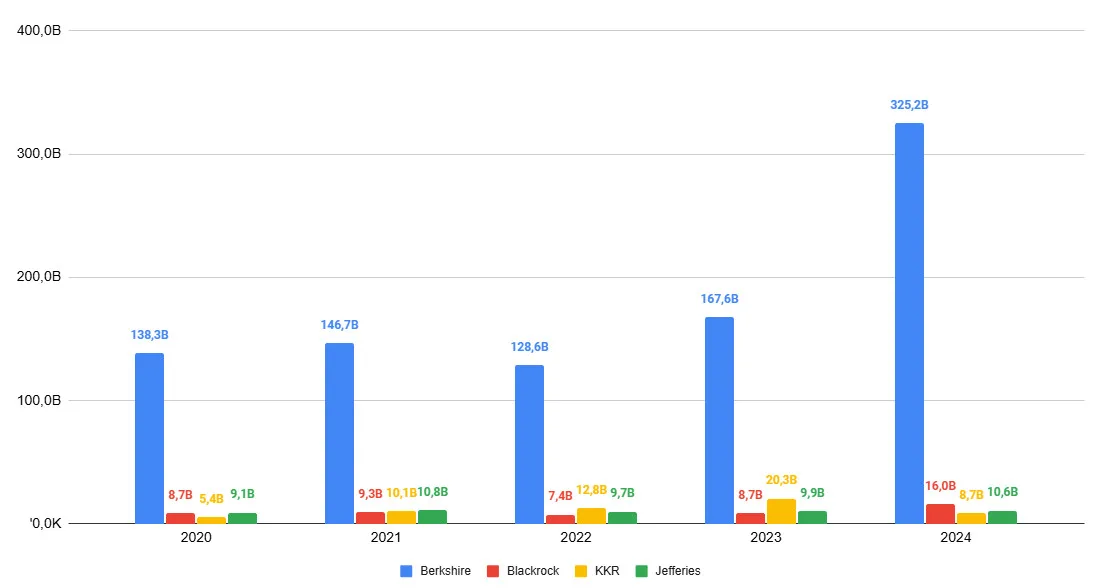
It’s worth noting that Buffett’s approach stands in stark contrast to his peers – while Berkshire holds $325 billion in cash, competitors like BlackRock ($16 billion), KKR ($8.7 billion), and Jefferies Financial ($10.5 billion) maintain significantly smaller reserves. This disparity reflects not just a difference in scale, but a fundamental divergence in investment philosophy.
The Psychology Behind Warren Buffett’s Cash Strategy
The psychological aspects of maintaining such large cash reserves are fascinating and often overlooked. While most investors feel an almost irresistible urge to stay fully invested, driven by the fear of missing out on potential gains, Buffett embraces the psychological comfort that comes with substantial cash positions. This emotional stability allows Berkshire to make rational decisions while others panic, creating a significant competitive advantage during market turbulence, as described above how BRK acted during crisis and turbulence.
The strategy isn’t without its critics, who argue that holding such large cash reserves represents a missed opportunity for higher returns. However, this criticism misses the broader strategic picture. Buffett’s cash pile isn’t merely idle capital – it’s potential energy waiting to be released at the optimal moment. This patience and willingness to wait for the right opportunity has been a hallmark of Buffett’s investment approach throughout his career, contributing significantly to Berkshire’s long-term success.
What Warren Buffett’s Cash Position Means for Individual Investors
While few investors can maintain cash reserves on Berkshire’s scale, the principles behind Buffett’s strategy offer valuable lessons for individual investors. The ability to maintain some cash reserves, resist the urge to chase overvalued assets, and remain patient during market exuberance are practices that can benefit investors at any scale. It’s not about trying to replicate Berkshire’s exact cash positions, but rather about understanding and applying the underlying strategic principles to one’s own investment approach.
Looking ahead, the value of Buffett’s cash-heavy strategy may become even more apparent. As markets continue to evolve and face new challenges, the flexibility and security provided by substantial cash reserves could prove increasingly valuable. Whether facing market corrections, global economic uncertainty, or emerging investment opportunities, having the resources to act decisively when others cannot remains a powerful advantage.
Learning from Warren Buffett’s Cash Management Strategy
The lessons from Berkshire’s massive cash position extend beyond simple investment strategy. They speak to broader principles of financial management, risk assessment, and the importance of maintaining flexibility in an increasingly uncertain world. For individual investors, this might mean maintaining higher cash reserves than conventional wisdom suggests, being more selective about investment opportunities, and having the patience to wait for truly compelling valuations before deploying capital.
Consider your own investment approach in light of Buffett’s strategy. While you don’t need billions in cash reserves, maintaining some dry powder for opportunities while resisting the urge to chase every market movement can provide both financial and psychological benefits. The key is finding the right balance for your situation while keeping in mind that sometimes the best investment decision is having the patience to wait for better opportunities.
Remember that Buffett’s success comes not just from knowing when to invest, but also from having the discipline to hold cash when suitable investments aren’t available. In today’s market environment, with elevated valuations across many sectors, this lesson may be more relevant than ever. Whether you’re a seasoned investor or just starting out, understanding why Warren Buffett maintains such large cash reserves can provide valuable insights for your own investment strategy.
While we can learn valuable lessons from studying Buffett’s approach to cash management, it’s important to remember that every investor’s situation is unique. Consider consulting with a financial advisor to determine the cash strategy that best aligns with your personal financial goals and circumstances.
Invest & trade with clarity. Chart like a pro with TradingView! (Affiliate Link)